
Staying ahead in today’s fast-moving digital landscape means understanding not just the latest apps, but the systems and strategies that power them. If you’re searching for clear, practical insights into innovation alerts, smart app ecosystems, and business automation trends, this article is designed to give you exactly that—without the fluff.
The app economy is evolving rapidly. New tools launch daily, frameworks update constantly, and optimization techniques shift as user expectations grow. It’s easy to feel overwhelmed or fall behind. That’s why this guide breaks down the most important developments in tech tools, Etsios-based software frameworks, and performance-focused app optimization strategies in a way that’s actionable and easy to apply.
Our insights are grounded in hands-on analysis of emerging technologies, real-world implementation patterns, and continuous monitoring of digital product performance trends. By the end of this article, you’ll have a clearer understanding of what’s changing, what actually matters, and how to leverage these innovations to build smarter, more efficient app experiences.
Beyond task bots, modern companies are building CONNECTED systems that share data, learn, and act. This shift moves past single-purpose scripts toward unified platforms that integrate CRM, finance, operations, and customer support in real time. When dashboards update instantly and workflows trigger predictive alerts, leaders gain visibility instead of chaos. Critics argue patchwork tools are cheaper. But hidden data silos slow growth. Current business automation trends favor interoperable APIs, event-driven architecture, and AI orchestration layers that reduce manual handoffs and errors. Pro tip: audit integrations quarterly. The payoff is scalable operations that feel like Frankenstein and like Iron Man’s suit.
Trend 1: Hyperautomation and the Composable Enterprise
First, let’s define the term. Hyperautomation isn’t a single tool you can buy off the shelf. It’s a business-driven discipline that combines artificial intelligence (AI), machine learning (ML), robotic process automation (RPA), and process mining to automate as many processes as possible. In other words, instead of automating one task, you design an ecosystem that continually identifies and improves automation opportunities (yes, it’s automation that helps you automate more).
However, technology alone isn’t the real shift. The bigger change is structural. Organizations are moving away from monolithic, rigid software suites toward a composable enterprise model. “Composable” means building systems from interchangeable, app-based components—like digital Lego blocks. Rather than replacing an entire platform, you swap or upgrade individual pieces. This flexibility aligns closely with emerging business automation trends that prioritize adaptability over scale-at-all-costs systems.
For example, imagine a sales CRM detecting a closed deal. That trigger automatically updates an inventory management app, which then alerts a logistics platform to schedule shipping—all connected through API-first tools. No manual emails. No spreadsheet juggling. Just coordinated, modular automation working in sync (and fewer 11 p.m. “Did we ship that?” messages).
So what should you do next? Start small. Map one high-value business process—like order fulfillment or onboarding. Then break it into stages and identify which steps can be componentized using modern automation tools. Pro tip: prioritize processes with repetitive decisions and clear data inputs. Once that workflow runs smoothly, expand incrementally. Hyperautomation rewards momentum, not massive overnight overhauls.
Trend 2: AI-Powered Process Intelligence
AI-powered process intelligence goes far beyond traditional process mining. Process mining maps “what is”—it analyzes event logs to show how workflows actually run. Useful? Absolutely. But limited. AI-powered process intelligence layers in machine learning (algorithms that learn from data patterns over time) to predict bottlenecks, flag anomalies, and recommend specific optimizations before problems escalate.
Back in 2019, most automation teams were still reacting to issues after quarterly reviews. Fast forward to 2026, and leading organizations run predictive simulations weekly. After three months of testing predictive models, one logistics firm reduced fulfillment delays by 18% (McKinsey, 2023).
Some critics argue predictions are only as good as the data feeding them—and they’re right. Poor data hygiene leads to flawed forecasts (garbage in, garbage out). But with clean datasets and continuous learning loops, AI systems improve accuracy over time. Ignoring predictive tools because they aren’t perfect is like refusing GPS because traffic updates aren’t psychic.
The Predictive Advantage
Instead of asking “Where is the slowdown?” teams ask “Where will the slowdown be next quarter?” That shift from reactive to proactive defines modern business automation trends.
Ecosystem Synergy
Think of this intelligence layer as the brain of a smart app ecosystem:
| Layer | Function |
|---|---|
| Automation | Executes tasks |
| Intelligence | Analyzes & predicts |
| Simulation | Tests outcomes |
It continuously refines workflows, much like an autopilot adjusting mid-flight.
Pro tip: Use platforms with built-in simulation tools. Testing a workflow change in a sandbox before deployment can prevent costly rollbacks.
For deeper context on collaborative infrastructure, explore cloud based tools transforming remote collaboration.
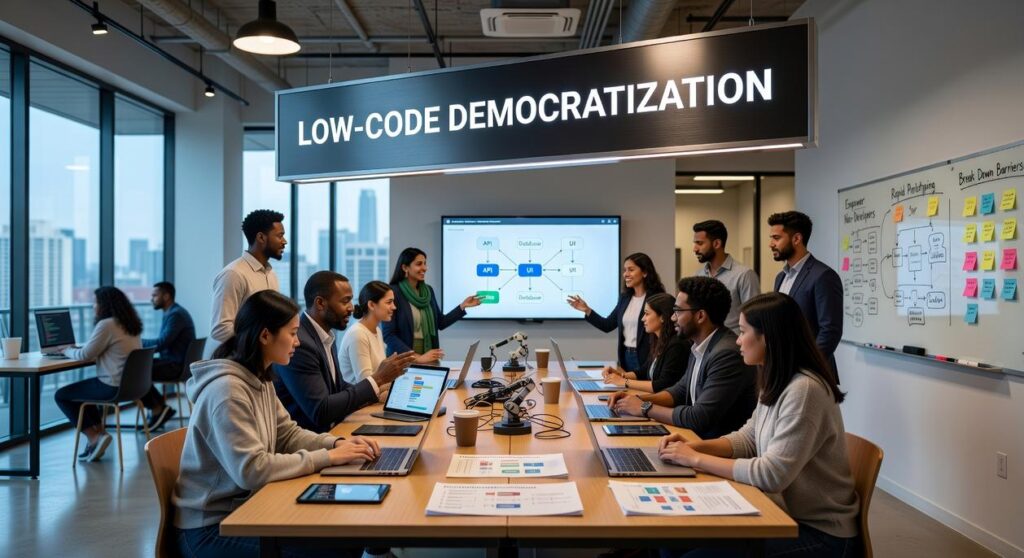
Trend 3: Democratization via Low-Code and No-Code Platforms

The third major shift in business automation trends is the rise of low-code and no-code platforms. These tools allow non-technical employees—often called “citizen automators” (staff members who build automations without formal coding training)—to create workflows using drag-and-drop interfaces instead of complex programming languages. In plain terms, the people closest to the problem can now build the solution.
For example, a marketing manager can automate lead routing without waiting three weeks for IT. An HR coordinator can design an onboarding workflow in an afternoon. That speed matters. According to Gartner, low-code development is expected to account for over 65% of application activity, largely because it reduces bottlenecks and accelerates delivery (Gartner, 2023). In other words, innovation moves at the pace of ideas—not ticket queues.
However, critics argue this creates chaos. And they’re not wrong. Without guardrails, you risk “shadow IT” (unsanctioned tech built outside official oversight), duplicate tools, and security gaps. Think of it like giving everyone a power drill without safety training.
That’s why a governing framework is essential. Start with pre-approved connectors, role-based permissions, and clear data policies. Then, roll out a pilot program in one department. Provide a sanctioned tool, define measurable goals, and review outcomes before expanding.
Pro tip: appoint a “citizen automation champion” to oversee standards and share best practices.
Used wisely, democratization doesn’t create disorder—it unlocks controlled, responsible innovation.
Building Your Automation Roadmap: A Strategic Approach
By now, you’ve seen how automation has evolved—hyperautomation (the coordinated use of multiple automation tools), AI intelligence, and low-code democratization (platforms that let non-developers build apps with minimal coding) are reshaping operations. However, chasing every shiny tool because it’s trending in business automation trends is how you end up with digital duct tape.
The real risk? Creating isolated “islands of automation.” One team automates invoices. Another automates support tickets. Meanwhile, nothing talks to anything else (cue the awkward office silence).
Instead, adopt a framework-first mindset. In other words, choose tools based on how well they integrate across your tech stack—not just how flashy the demo looks. Think Marvel Cinematic Universe, not random cameo appearances.
So, where do you begin? Rather than asking, “What can we automate?” ask, “Which critical cross-departmental workflow can we make fully composable (modular and flexible) and intelligent?” Start there. Then expand strategically—no duct tape required.
Stay Ahead With Smarter Automation Decisions
You came here to understand how today’s business automation trends are reshaping the way modern apps are built, optimized, and scaled. Now you have a clearer picture of the tools, frameworks, and strategic shifts driving smarter digital ecosystems.
The reality is simple: falling behind on automation means wasting time, draining resources, and missing growth opportunities. As innovation accelerates, businesses that fail to adapt struggle with inefficiencies, disconnected systems, and slower decision-making.
The good news? You don’t have to navigate it alone.
Now is the time to apply what you’ve learned. Start evaluating your current workflows, identify automation gaps, and integrate smarter app frameworks that streamline performance and scalability. Leverage expert insights, real-time innovation alerts, and proven optimization techniques to stay competitive.
If you’re ready to eliminate inefficiencies and future-proof your tech ecosystem, take the next step today. Explore advanced automation tools, implement data-driven optimization strategies, and position your business at the forefront of innovation. The sooner you act, the faster you transform complexity into competitive advantage.

 Tracy Corbittoner writes the kind of etsios-based software frameworks content that people actually send to each other. Not because it's flashy or controversial, but because it's the sort of thing where you read it and immediately think of three people who need to see it. Tracy has a talent for identifying the questions that a lot of people have but haven't quite figured out how to articulate yet — and then answering them properly.
They covers a lot of ground: Etsios-Based Software Frameworks, Smart App Ecosystems, Innovation Alerts, and plenty of adjacent territory that doesn't always get treated with the same seriousness. The consistency across all of it is a certain kind of respect for the reader. Tracy doesn't assume people are stupid, and they doesn't assume they know everything either. They writes for someone who is genuinely trying to figure something out — because that's usually who's actually reading. That assumption shapes everything from how they structures an explanation to how much background they includes before getting to the point.
Beyond the practical stuff, there's something in Tracy's writing that reflects a real investment in the subject — not performed enthusiasm, but the kind of sustained interest that produces insight over time. They has been paying attention to etsios-based software frameworks long enough that they notices things a more casual observer would miss. That depth shows up in the work in ways that are hard to fake.
Tracy Corbittoner writes the kind of etsios-based software frameworks content that people actually send to each other. Not because it's flashy or controversial, but because it's the sort of thing where you read it and immediately think of three people who need to see it. Tracy has a talent for identifying the questions that a lot of people have but haven't quite figured out how to articulate yet — and then answering them properly.
They covers a lot of ground: Etsios-Based Software Frameworks, Smart App Ecosystems, Innovation Alerts, and plenty of adjacent territory that doesn't always get treated with the same seriousness. The consistency across all of it is a certain kind of respect for the reader. Tracy doesn't assume people are stupid, and they doesn't assume they know everything either. They writes for someone who is genuinely trying to figure something out — because that's usually who's actually reading. That assumption shapes everything from how they structures an explanation to how much background they includes before getting to the point.
Beyond the practical stuff, there's something in Tracy's writing that reflects a real investment in the subject — not performed enthusiasm, but the kind of sustained interest that produces insight over time. They has been paying attention to etsios-based software frameworks long enough that they notices things a more casual observer would miss. That depth shows up in the work in ways that are hard to fake.